Four foot tactile switch, as the name suggests, has a tactile switch with four legs. Four foot tactile switches are commonly used in daily products and occupy a relatively large part. The four pins referred to here are the four pins of the tactile switch. The four pins have two groups of switches, and when pressed, both groups are powered on at the same time. When released, both groups are turned on at the same time. Some people say that these four pins are for the purpose of firmly soldering the circuit board, but this understanding is also correct.
Whether it is a four foot tactile switch or other tactile switches, their working principles are quite similar, partly due to the different number of pins and switch division, resulting in some fundamental differences in their working principles. What is the working principle of the four foot tactile switch?
Working principle of four foot tactile switch
1、 Composed of a combination of normally open and normally closed contacts, in a four foot light touch switch, the function of the normally open contact is to present a connected state when pressure is applied to the normally open contact; When this pressure is released, it returns to the original normally closed contact point, also known as disconnection. The force of this pressure is the action of using our hands to turn on and off the button.
2、 When the pressure is released, the four foot touch switch will be turned off. The internal structure of the four foot touch switch relies on metal spring plates to protect the force situation and achieve connection and disconnection.
3、 The principle of a four foot tactile switch is related to its structure. For example, after passing through a light bulb H and a rectifier full bridge, 220V AC power becomes a DC pulsating voltage, which is used as a forward bias and applied to the thyristor VS and R branches.
1. During the day, when the brightness exceeds a certain level, the photodiode D exhibits a bottom resistance state of ≤ 1K Ω, causing the transistor V to cut off and its emitter to have no current output. The unidirectional thyristor VS is blocked due to the absence of trigger current. At this time, the current flowing through bulb H is ≤ 2.2mA, and bulb H cannot emit light. The resistor R1 and the voltage regulator diode DW ensure that the bias voltage of the transistor does not exceed 6.8V, providing protection for the transistor.
2. At night, when the brightness is below a certain level, the photodiode D exhibits a high resistance state of ≥ 100K Ω, causing the transistor V to conduct forward and the emitter to have a voltage of about 0.8V, triggering the thyristor VS to conduct and causing the light bulb H to emit light. RP is a brightness selection component that switches between morning and evening.
4、 Regardless of the structure of the tactile switch, the common feature of the four foot tactile switch is that it has four pins. The advantage of the four foot tactile switch over the ordinary tactile switch is that it can be firmly soldered, and everyone can accurately use the four foot tactile switch for adjustment and control.

 Product Center
 English
 Chinese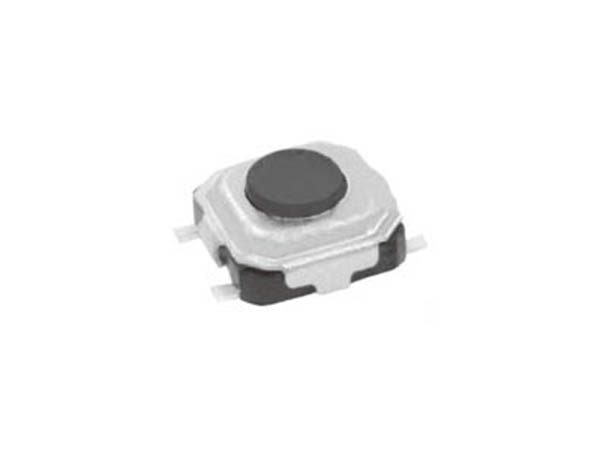
![[WeChat Consultation]](http://memberpic.114my.cn/dghengyi/uploadfile/image/20200527/20200527100150_1886714332.png)